
Agentic UX Architecture — Regulated Content Management
Designing for agentic AI isn’t just about generating copy or adding chat widgets—it’s about establishing Information Architecture rigor and cross-system boundaries upstream. Rapid AI prototyping can easily outpace product definition and create cognitive noise, but disciplined UX architecture grounds agent capabilities into clear, trustworthy human workflows. To showcase how to connect compliance systems of record with generative systems of creation, I break down two interconnected phases where I served as Principal UX Designer.
Cross-System Architecture (System of Record to Creation)
A case study in cross-system architecture: extending compliance intelligence upstream by defining the interaction contracts between a regulatory system of record and a generative AI authoring canvas.
Workspace Architecture (System of Record Foundation)
A case study in zero-to-one platform foundation: replacing legacy document storage with an enterprise system of record for pharmaceutical MLR review, and establishing a scalable workspace architecture to ground AI capabilities in structured compliance data.
PART 1: Workspace Architecture — System of Record Foundation
What Is Regulated Content Management?
In regulated industries, every piece of content is a compliance decision—yet legacy tools were built to store static documents, not manage compliance data. Today, pharmaceutical and healthcare review teams operate across manual, disconnected systems:
Manual Verification: Reviewers check claims by hand against external spreadsheets and cross-reference obligations buried in static SOPs.
Ungoverned Risk Tiers: Because compliance logic lives in a reviewer’s head rather than in structured system rules, almost every asset is forced down the same heavy review path regardless of risk.
Fragmented Audit Lineage: Audit evidence must be manually collated from disparate records, dragging Medical, Legal, and Regulatory (MLR) cycles out for weeks and making global updates take months to cascade.
Regulated Content Management (RCM) was built as a zero-to-one platform foundation focused first on Life Sciences Cloud to replace this fragmented process with an integrated system of record, anchored on two core pillars:
End-to-End Content Lifecycle Management: Orchestrating multi-tier MLR review workflows, electronic signatures, versioning, and auditable governance across modern digital formats (PDF, HTML, Email, SMS, and RCS).
The CORS Compliance Framework: Structuring compliance data directly into the system by connecting every digital asset to its underlying Claims (scientific assertions), Obligations (regulatory and channel rules), References (approved supporting assets), and Substantiation (clinical trial evidence).
In high-stakes healthcare, content isn't just marketing—it's compliance. A single unapproved claim can trigger millions in regulatory fines. RCM was designed to compete directly with incumbents like Veeva Vault and PromoMats by replacing document silos with structured, auditable compliance intelligence.
The Problem: Navigating the "AI Speed Trap"
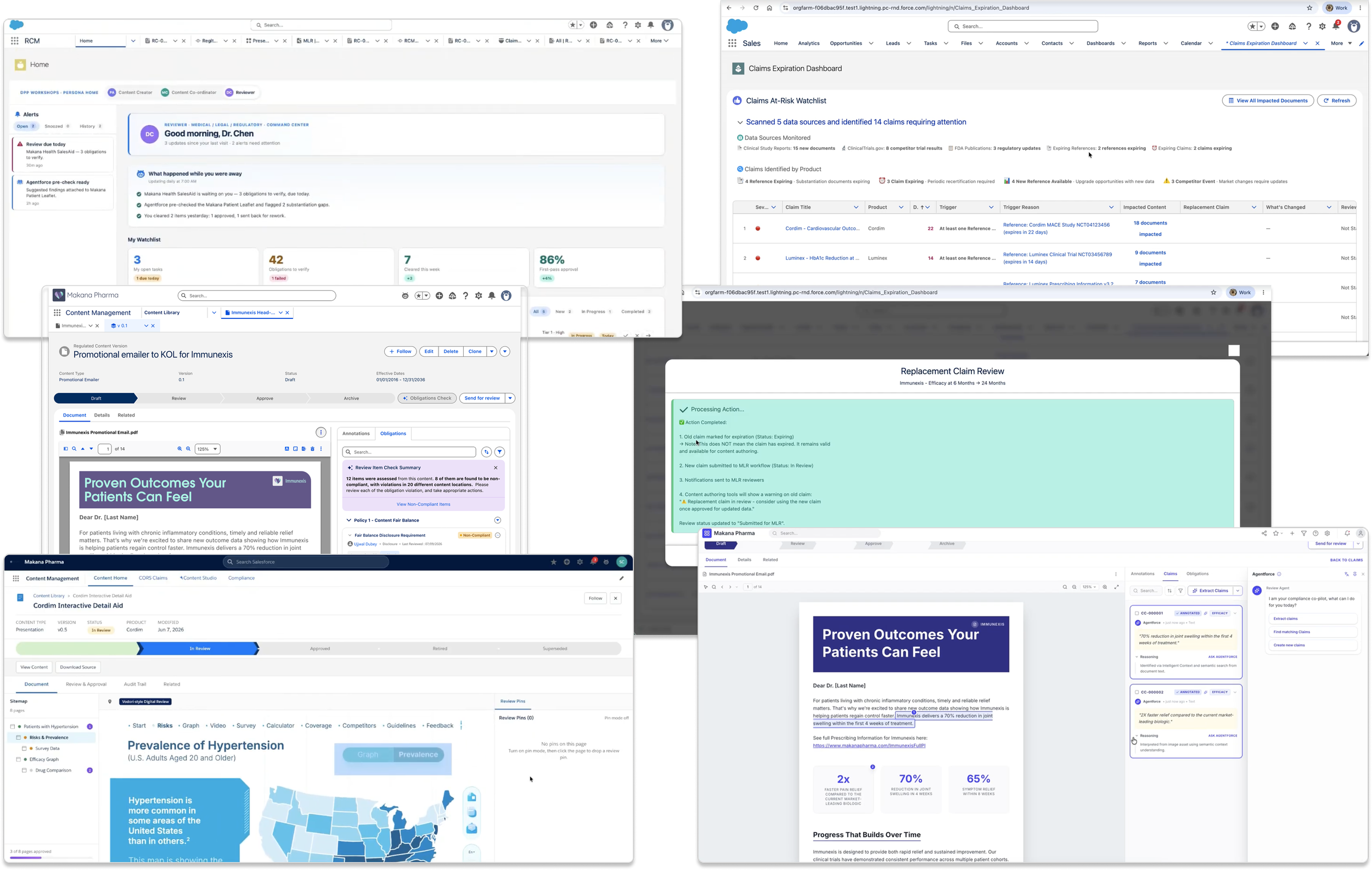
As our cross-functional team incorporated AI into RCM, we ran into a modern zero-to-one challenge: the AI Speed Trap. Rapid AI prototyping was moving faster than our core product definition—and worse, those prototypes completely lacked scalability.
Teams were taking user requirements very literally: if a requirement said "we need compliance obligations on content," the quick prototype solution was simply to tack yet another tab onto the page. But patching features onto the UI created immense visual noise and unnecessary steps—introducing cognitive friction and burying the critical information reviewers actually needed right when they needed it most

Grounding Scope via GA Mapping
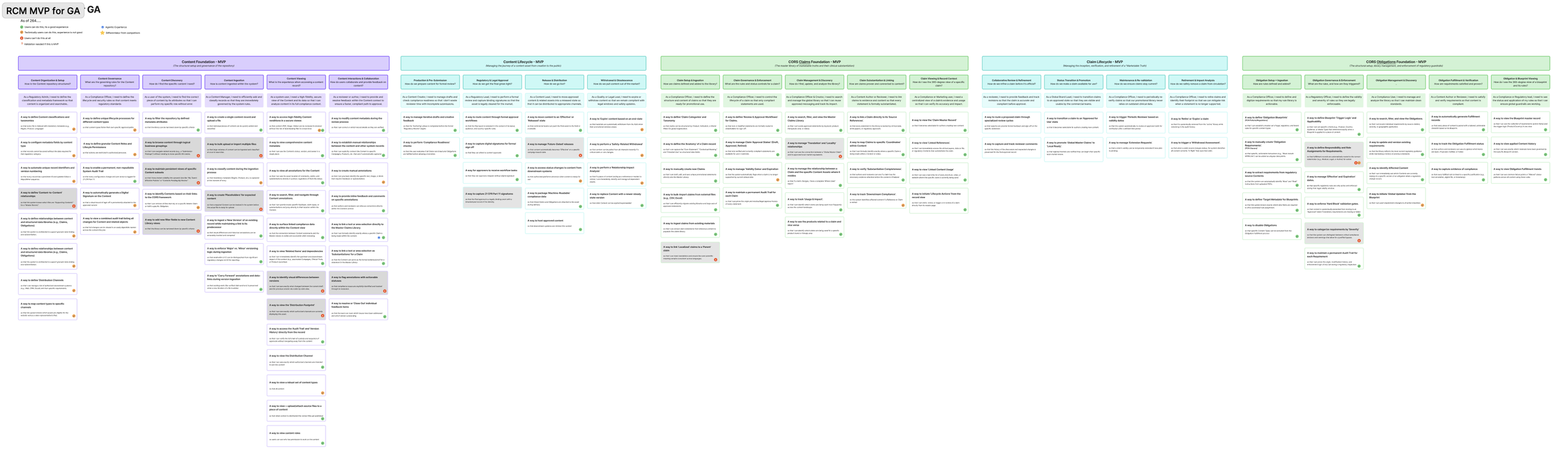
To stop reactive prototyping and establish true GA scope, I facilitated a structured GA Mapping exercise directly with Product Management leadership. Rapid prototyping had left our cross-functional team debating isolated UI features without a shared understanding of what was truly required for a viable enterprise launch.
I structured a workshop framework that deconstructed our entire product surface into four hierarchical tiers:
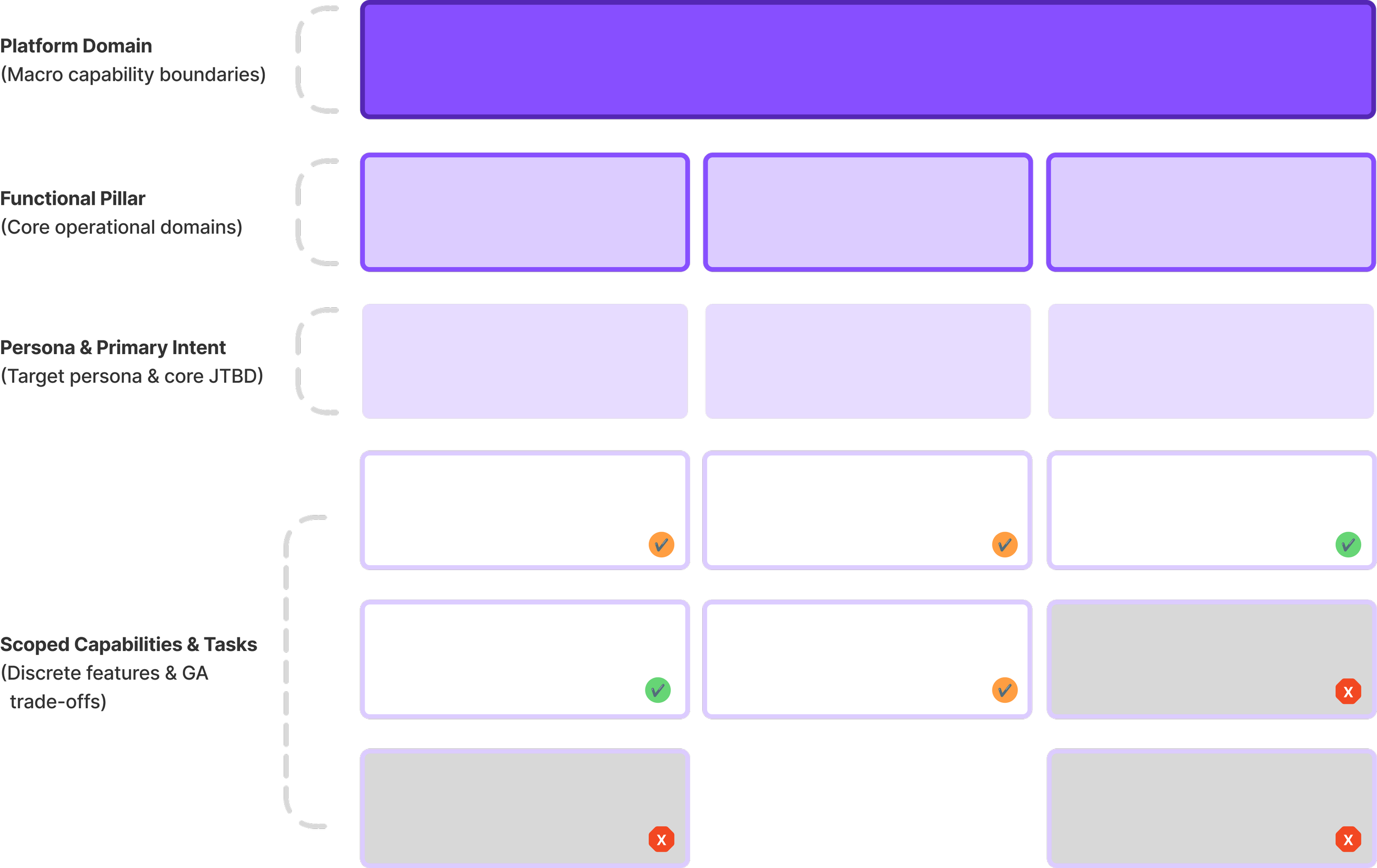
We mapped every proposed capability across the matrix and stress-tested each row against three strict operational ratings:
Ideal: A native, fully supported workflow designed for high-frequency user tasks.
Workaround: A path achievable using existing Salesforce platform patterns that met user goals without blocking launch.
Critical Gap: An architectural blocker with no viable workaround that would cause user failure or regulatory non-compliance.
Upstream UX & PM Alignment
The GA Mapping matrix established a shared strategic baseline between UX and Product Management:
Replaced Subjective Debates with Objective Prioritization: Ended speculative arguments over the latest UI prototypes ("should we add another tab for this?") by forcing every proposed feature through an objective matrix—giving PM and UX a shared lens to distinguish true launch blockers from non-essential noise.
Defined Clear Boundaries Between "Must-Solve" and "Acceptable Workarounds": Identified the critical compliance gaps that required net-new UX investment versus tasks that could be handled through existing platform patterns, giving PM the leverage to defend a focused, realistic launch scope.
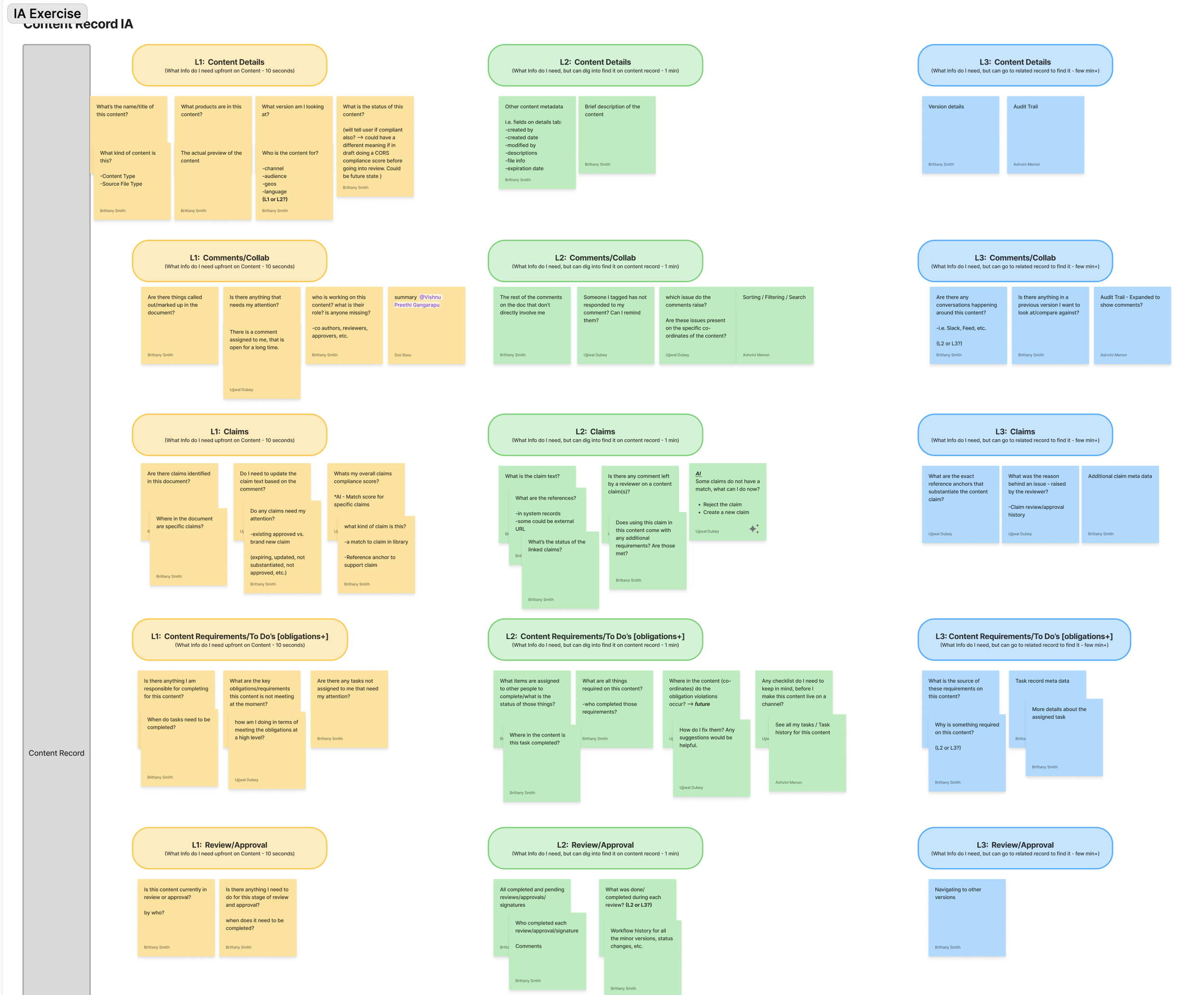
The L1/L2/L3 Workspace Framework: Information Architecture in Practice
Following GA Mapping, we focused our Information Architecture rigor on the operational anchor of RCM: the Regulated Content Record. This is the "hero" interface where content owners, MLR reviewers, and approvers spend 90% of their time collaborating, annotating, and clearing assets.
To stop the cycle of tacking on new tabs for every feature, we stepped back to establish three enduring IA principles and an information-layering model grounded in user urgency rather than UI real estate.
Core IA Principles
Simplicity Through Progressive Disclosure
Layer information so reviewers only see what they need when they need it. Surface immediate orientation up front, keep active workflow tools contextual, and preserve full regulatory auditability without letting compliance density overwhelm the screen.
Enable User Efficiency in a Single Context
High-frequency review tasks should never require cross-screen context switching. Within a single view, a reviewer must be able to instantly understand what the content is, know what needs to be done, and take action alongside the asset.
Flexibility & Architectural Scalability
The layout must accommodate evolving regulatory workflows, new media channels (like RCS), and expanding agentic AI capabilities without requiring structural UI redesigns every release cycle.
The Information Layering Model: Urgency Over UI
Rather than organizing the interface around backend data objects, we categorized information by user urgency and cognitive demand:
Translating Layers into Contextual Workspaces
To bring these layers into production, we established clear spatial roles between the primary canvas and supporting panels:
The Document Viewer (The Primary Canvas):
The asset preview remains the uninterrupted center of gravity. Whether evaluating a PDF brochure, email template, or RCS message, all inline annotations, claim highlights, and version comparisons happen directly on the asset canvas.
The Contextual Right Panel (The Dynamic Engine):
Instead of scattering new tools across disparate tabs, we designated the right-hand panel as an extensible, dynamic engine. It adapts its contents to the user’s role and lifecycle stage without altering the surrounding layout: .
Static Record Anchors & Deep Dives (L2/L3):
Predictable top-level tabs protect reviewer muscle memory for sub-two-minute operational lookups (metadata, approval paths), while deep-dive drill-ins house dense audit histories and clinical substantiation off-canvas for compliance investigators.
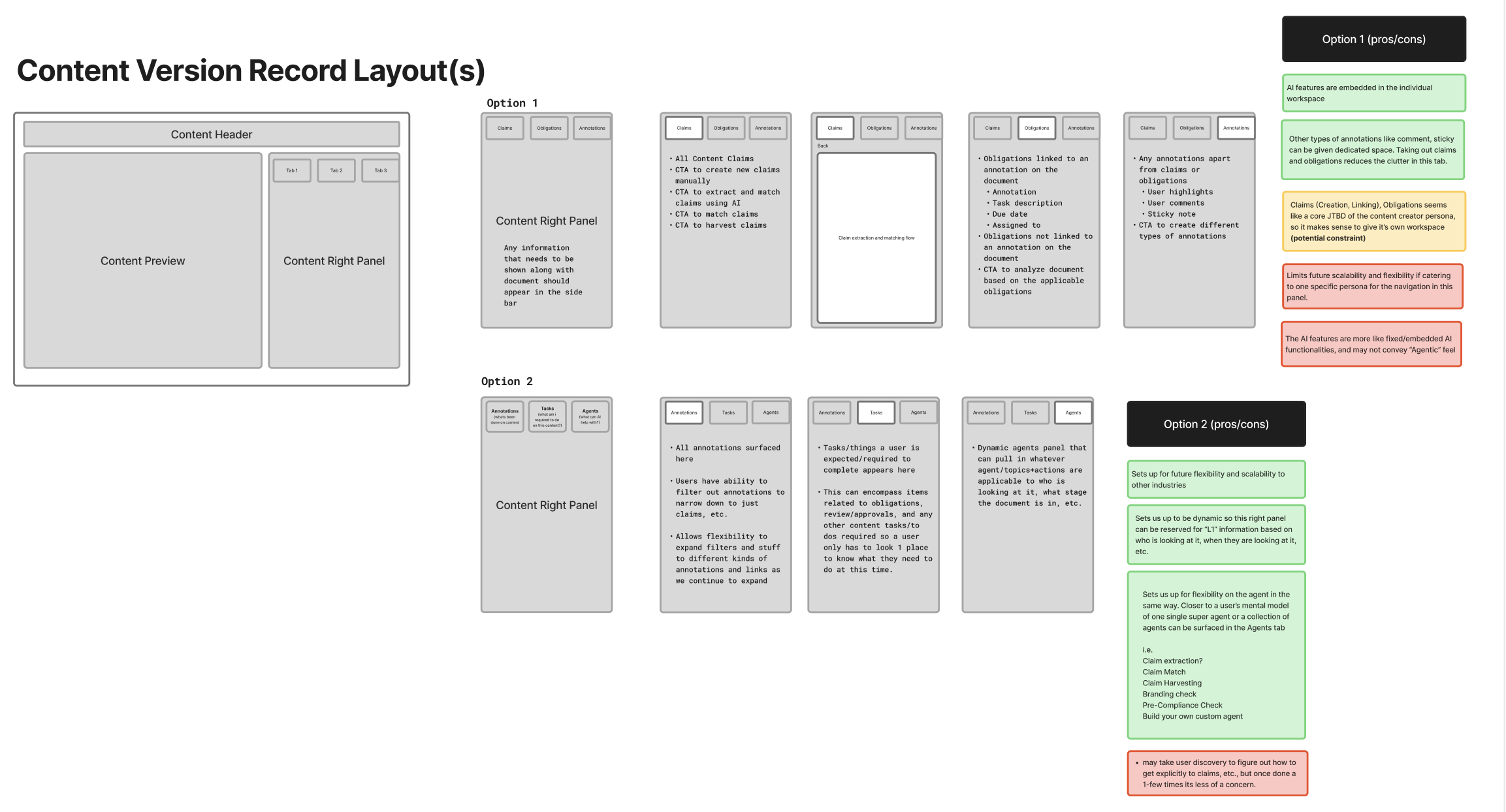
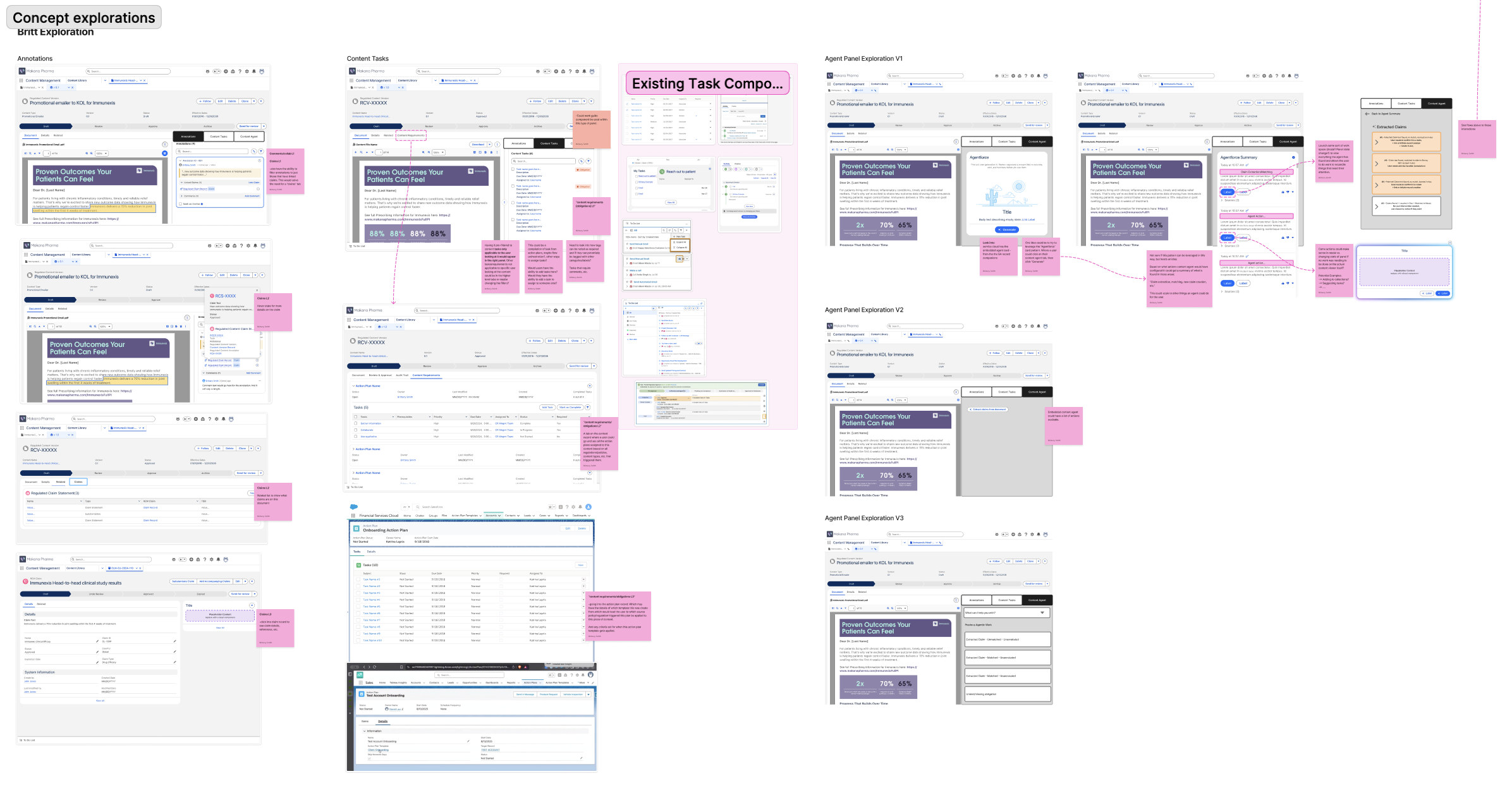
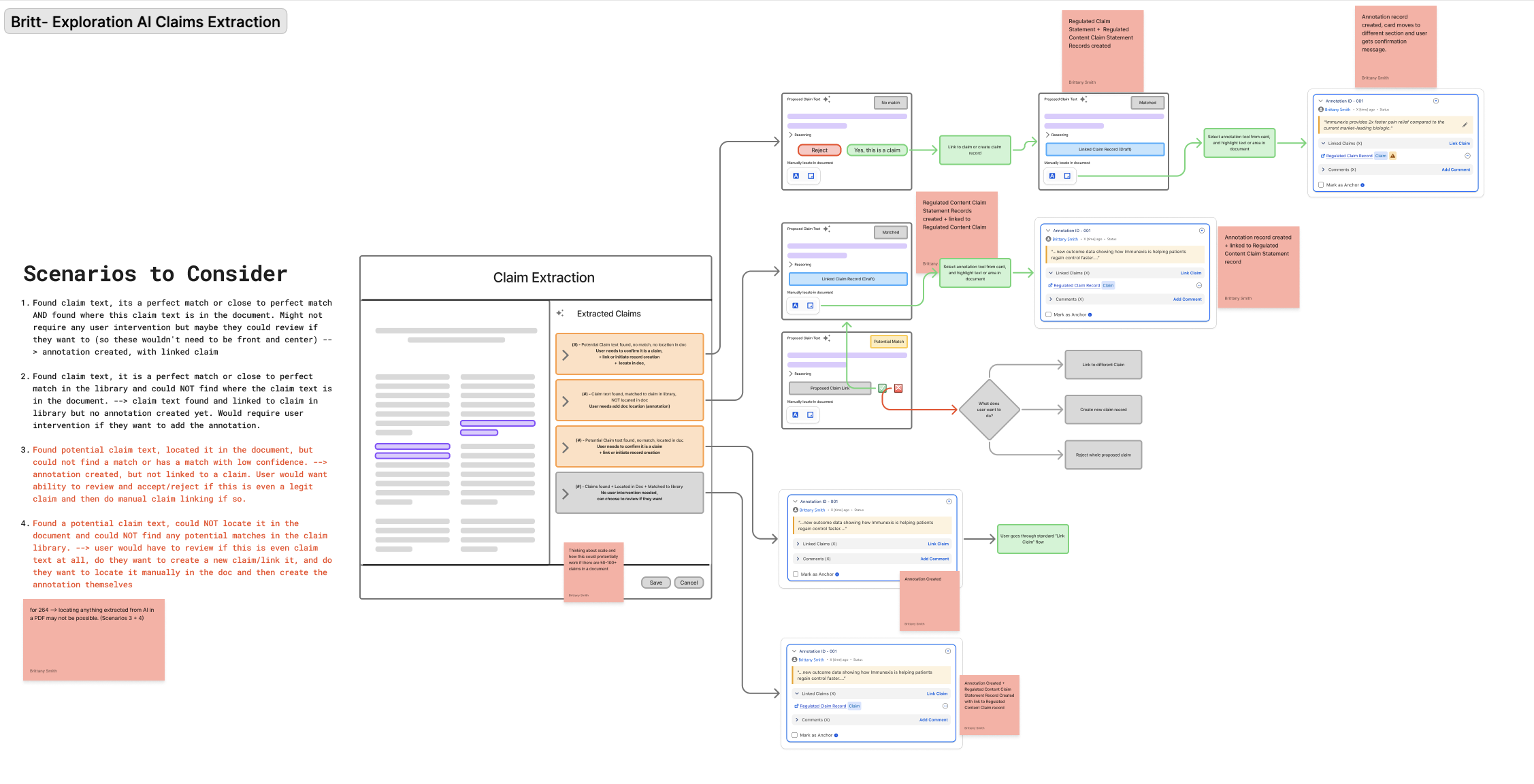
Embedded Agentic Primitives in Action (Design Partner Validation)
We didn't test our L1/L2/L3 container model as an abstract Information Architecture exercise—we brought these workspace designs directly into testing with our enterprise Design Partner customers to validate how the L1 container dynamically adapts across distinct persona workflows and lifecycle stages without fracturing the layout.
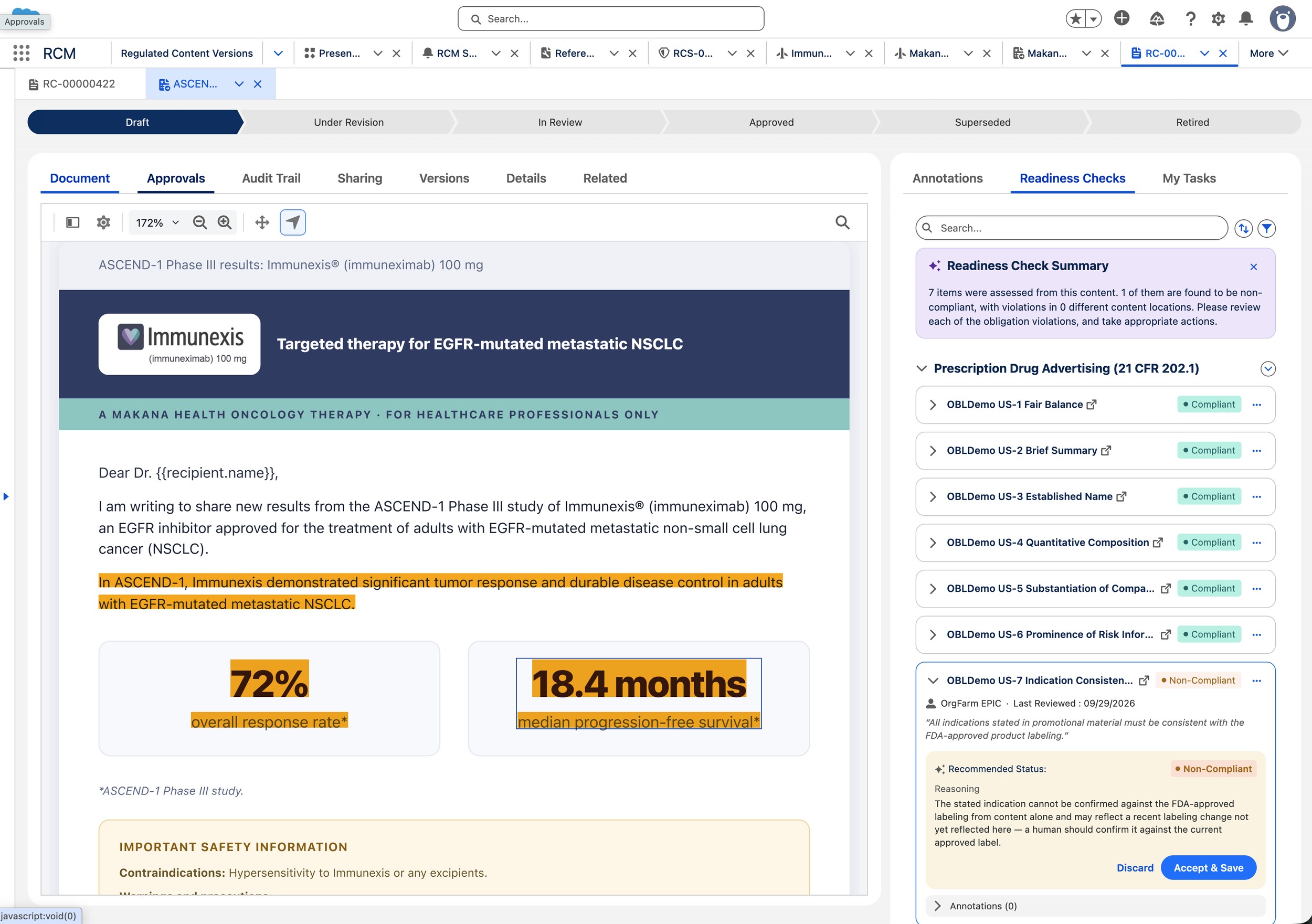
The interface below shows that dynamic L1 right panel evolving in practice across two core operational moments:
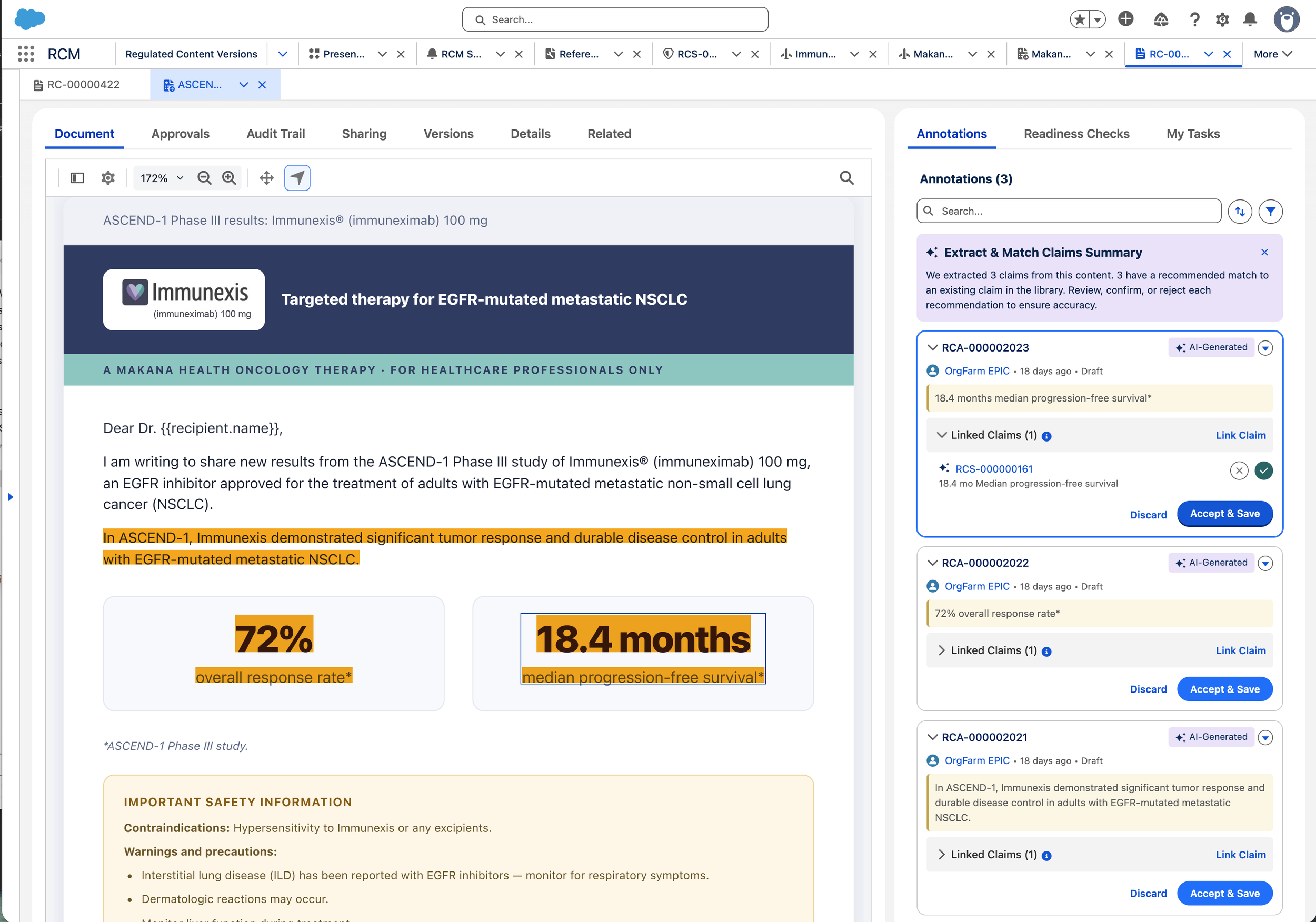
Claims Extraction & Matching
Primary Persona: Content Owners and Review Coordinators upon content ingestion.
Workflow Stage: Initial ingest and claim registration.
The moment content is uploaded, the L1 panel activates an embedded agent that scans draft copy in real time to isolate and highlight proposed clinical assertions (e.g., response rates, survival data). The engine matches text against verified CORS clinical references in the central compliance library—allowing coordinators to verify existing claims or author and catalog net-new ones directly within the panel
Obligations & Policy Enforcement
Primary Persona: Content Owners and Review Coordinators upon content ingestion, and Content Reviewers/Approver.
Workflow Stage: Pre-MLR submission and clearance.
Pre-MLR review, the same L1 surface dynamically transitions to automated Readiness Checks, evaluating copy against live regulatory rule sets (such as Fair Balance and mandatory drug-naming standards). The agent flags non-compliant text directly inline with explainable reasoning and supporting evidence—enabling reviewers to catch audit gaps and resolve compliance discrepancies before formal submission.
PART 2: Cross-System Architecture — Extending Compliance into Systems of Creation
Where Can RCM Data Add Value Upstream?
Once RCM was validated as an effective System of Record for review, we turned to the second phase of our architecture: extending RCM intelligence directly into systems of creation.
To ground our approach in actual user behavior rather than hypothetical features, I initiated tool-agnostic discovery sessions with our enterprise Design Partner Program (DPP) customers. We mapped out the end-to-end content drafting lifecycle across agency copywriters, brand managers, and regulatory leads to locate where compliance data could actively facilitate creation rather than disrupt it.
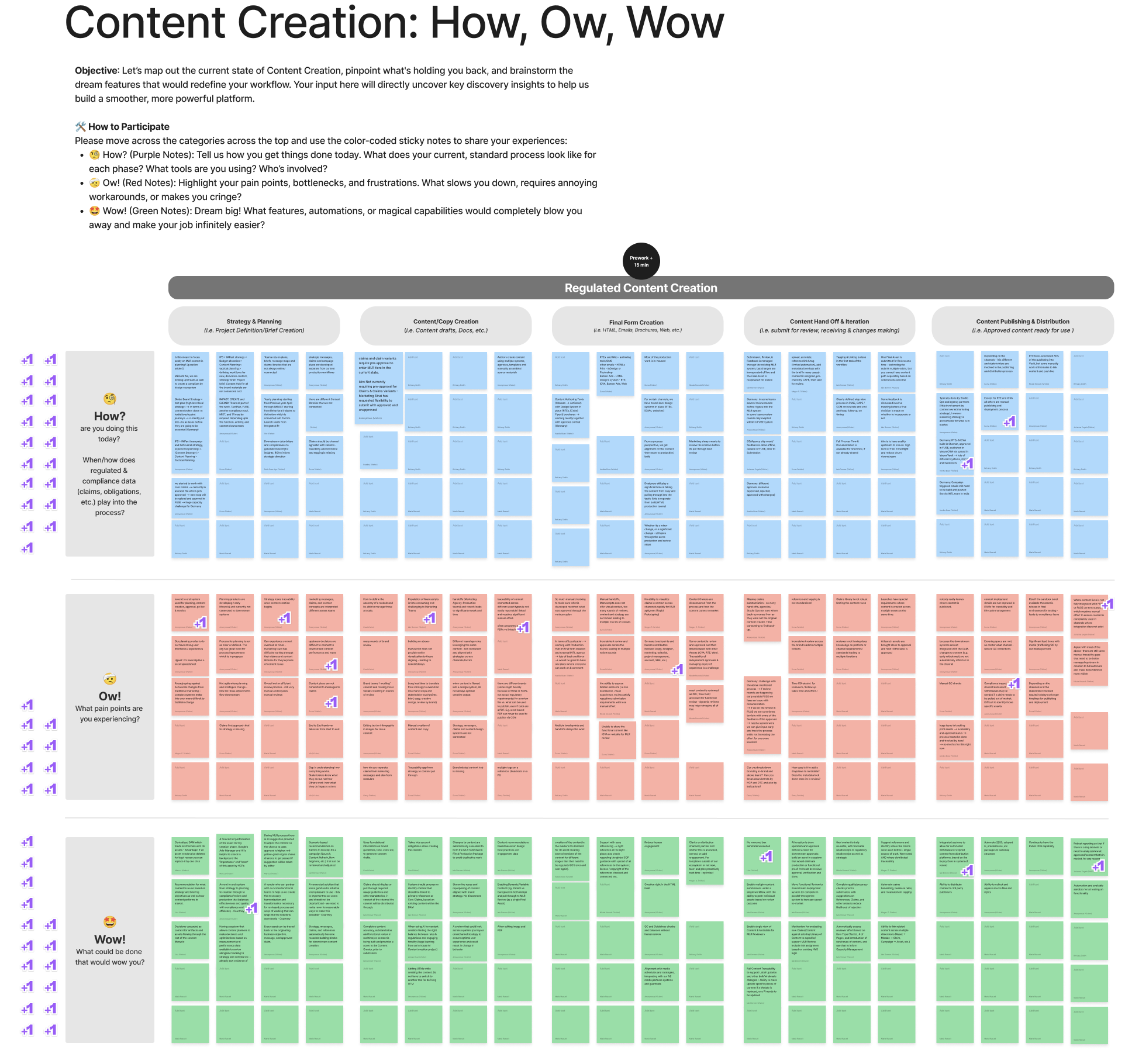
Across these sessions, we uncovered three systemic pain points:
Fragmented Tooling & Heavy Handoffs: Disconnected tools across drafting, approval, and publishing forced manual data re-entry and created severe organizational friction between creative teams and regulatory leads.
Costly Pre-MLR Rework: Manual, unguided pre-review workflows led to expensive, repetitive rework cycles to re-align claims and mandatory disclosures long after content had already been fully designed.
Demand for Upstream Agentic QC: Design partners made it clear that creators did not want post-hoc policing; they wanted intelligent AI to validate claim evidence, channel rules, restrictions, and brand guardrails directly during active creation.
Connecting Systems of Record to Systems of Creation
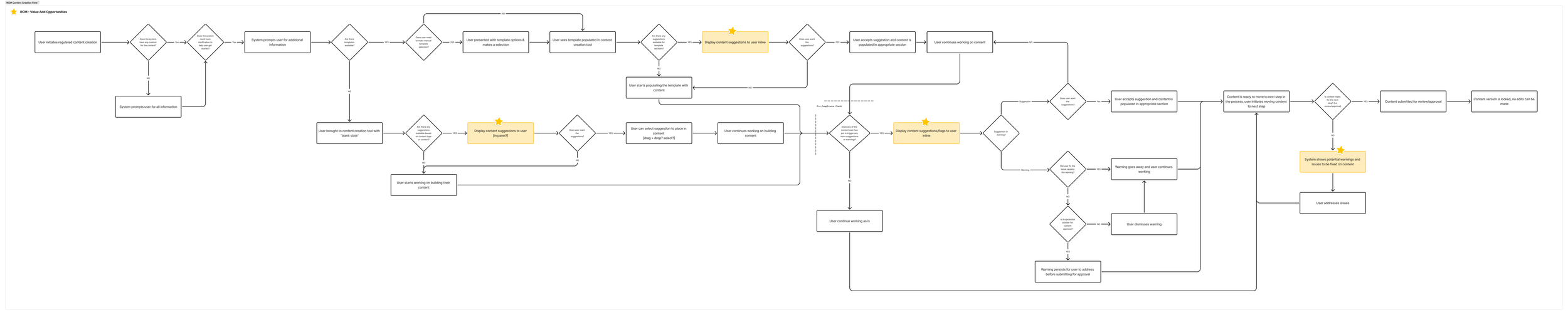
Taking those discovery insights, I mapped out an overarching interaction model to bridge our compliance System of Record with external creation surfaces.
Because UX Architecture was not dictating the individual UI of third-party or partner authoring tools, I anchored the approach entirely on user flow and mental models, establishing two core guardrails:
Identifying Handoff Zones: We mapped user mental models across diverse drafting environments to isolate the natural touchpoints where compliance data genuinely helps creators (e.g., brief intake, asset assembly, pre-flight checks) rather than interrupting their creative flow.
Context-Aware Governance Flows: We defined exactly what compliance data was needed and when it should appear—ensuring regulatory governance operates as an ambient, supportive guide in the background rather than an intrusive blocker.
This provided a flexible, tool-agnostic blueprint defining what intelligence needed to surface and at what lifecycle stage. To determine how it would manifest in production, I partnered directly with the design team building Salesforce’s native authoring canvas: Agentic Content Studio (ACS).
Applied Architecture: Agentic Content Studio (ACS)
To integrate RCM with Agentic Content Studio, our teams first aligned on an unambiguous system boundary: RCM owns submission, MLR review, and approvals; ACS owns creative authoring and generative assistance.
Instead of repeating the "AI Speed Trap" by bolting heavy compliance panels or manual obligation controls onto their canvas, I led collaborative UX architecture sessions to translate our compliance data into four core interaction contracts.
*My scope: the handoff contract and interaction direction. ACS's own design team owns the authoring-surface UI.
Brief-to-Claims Contract
We anchored campaign briefs directly to live RCM claims—positioning core scientific statements (e.g., "this drug is 20% more effective") as foundational grounding data so generative AI agents write compliant copy from line one.
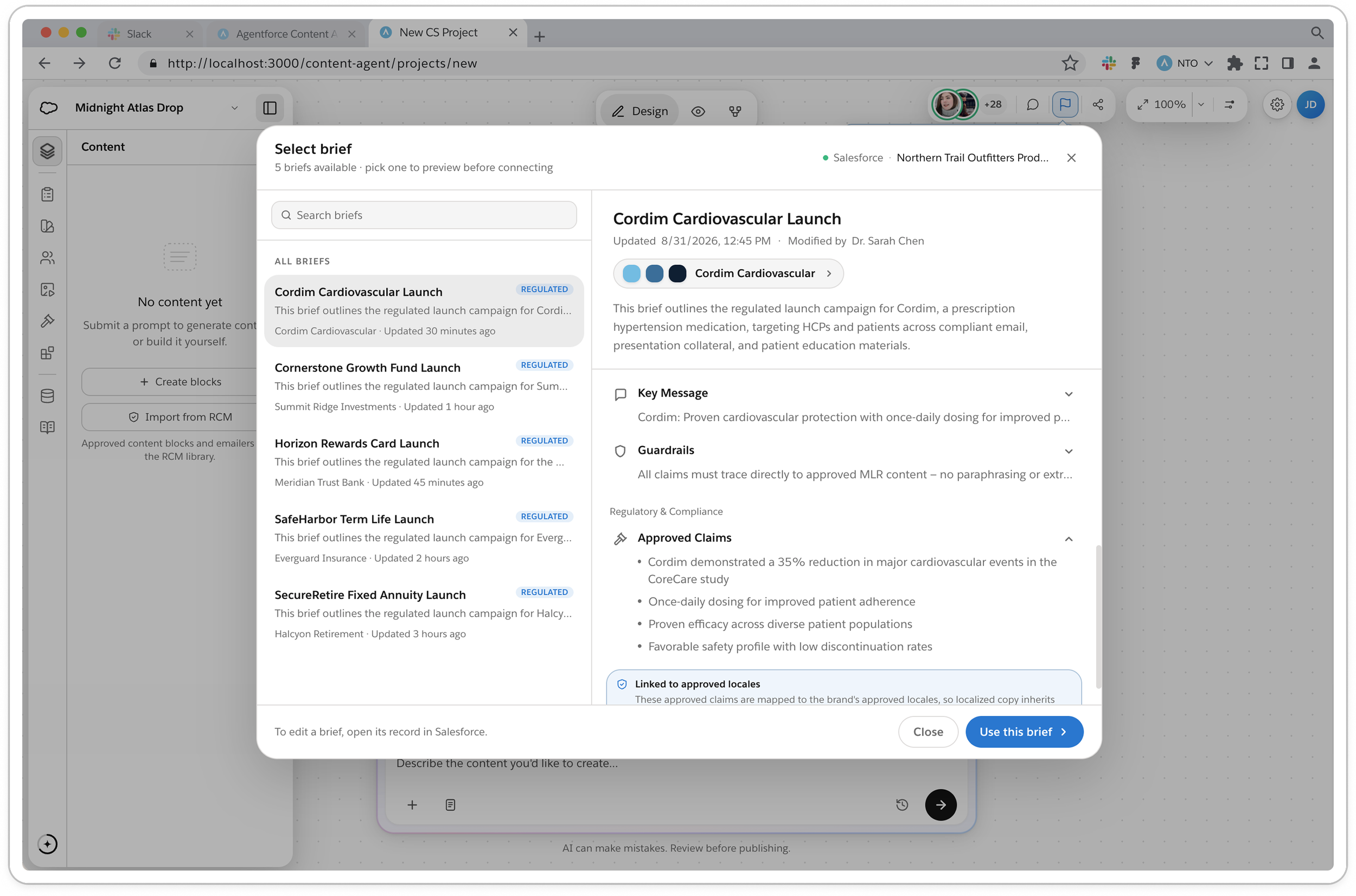

In-Flow Claims Pattern
Specified how pre-approved claims and regional rules surface inside the author's workspace — the pattern ACS built into their canvas.
Compliance Verification
Real-time policy checks during drafting—automatically inferring context like target audience, geographic region, and channel to surface inline compliance warnings before content ever enters formal review queues.
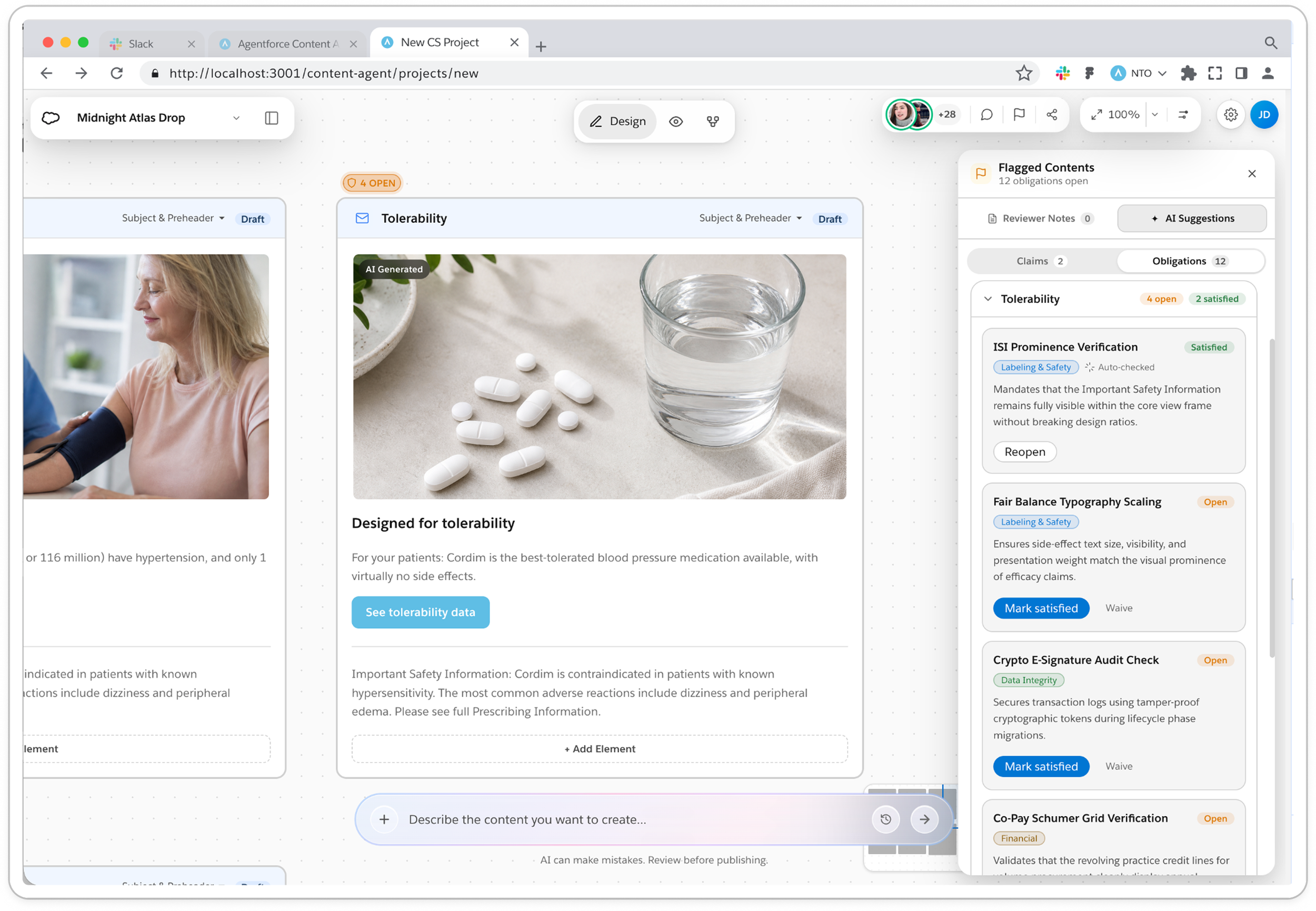

Closed-Loop Feedback
Routing MLR reviewer annotations directly back into the authoring surface as actionable fixes and consolidated feedback across systems.
The Impact: Trust & Traceability in AI-Accelerated Creation
The primary value of establishing this Information Architecture was giving cross-functional teams a durable, scalable framework to build compliant AI workflows without cluttering the user workspace.
Systemic IA Standard
Replaced one-off UI patches with an L1/L2/L3 progressive disclosure architecture that keeps the workspace clean as agent capabilities evolve.
Cross-System Alignment
Built 4 interaction contracts bridging compliance records (RCM) directly into generative authoring (ACS) using shared data patterns.
Market & Customer Validation
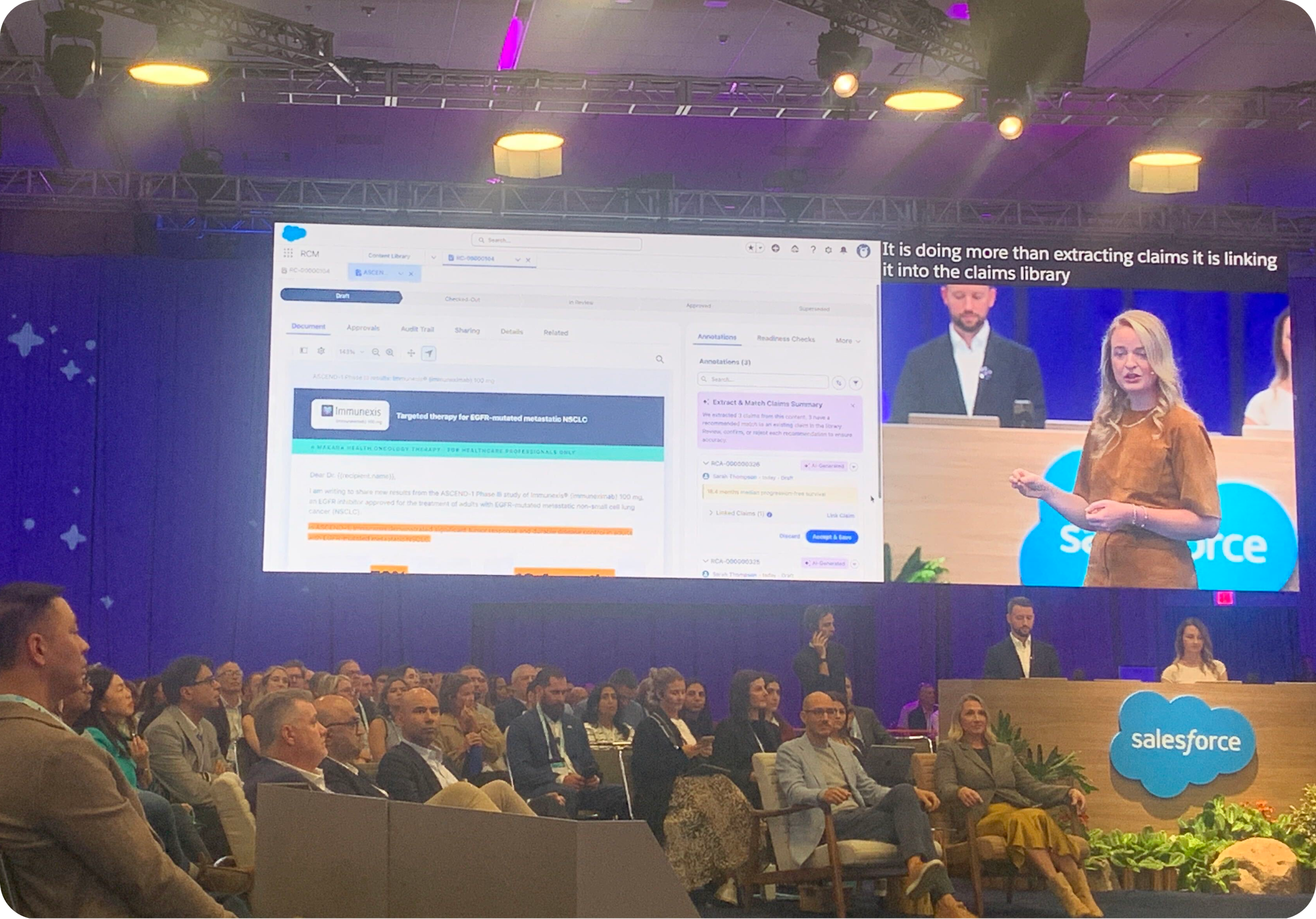
Validated directly in Design Partner pilots, featured live on stage in the Dreamforce 2026 Keynote, and on track for a February 2027 GA release.
WHAT'S NEXT?
Looking ahead, we are actively testing the adaptability of these interaction models across two new discovery frontiers:
Multi-Industry Scale (Currently In Discovery)
While Life Sciences served as our anchor vertical, we are actively testing how our workspace contracts adapt as we expand into Financial Services and Manufacturing. We are validating that our approval chains, reviewer mental models, and CORS compliance primitives scale seamlessly into completely different regulatory environments without re-architecting the core platform experience
RCM in Headless Surfaces (Currently In Discovery)
We are investigating headless workflows to solve a core UX dilemma: how do we enable compliance checks across non-canvas surfaces—like conversational agents, messaging tools, or integrated feeds—without losing critical visual context? In high-stakes MLR review, evaluating content rendered in its true visual layout is often non-negotiable. We are identifying which tasks users trust handling in a headless environment versus where they still demand visual proof on a full canvas before granting final sign-off.